Assessment adaptation for the Age of AI
When answers are easy, assess the reasoning.
Akanya helps institutions make student evidence, judgement and revision visible inside the assessments they already run.
Designed for lecturers. Structured for institutions. Built around human judgement.
Designed for equitable, low-bandwidth assessment. No cameras. No surveillance. No additional hardware.
Why Akanya
The student's role is changing.
A final answer can now be fluent without showing what the student understood. Akanya keeps the answer, then adds the evidence, challenge and judgement that formed it.
AI can produce
A polished answer, calculation or recommendation in minutes.
Institutions still need to assess
Whether the student can select evidence, reason and exercise judgement.
Akanya makes visible
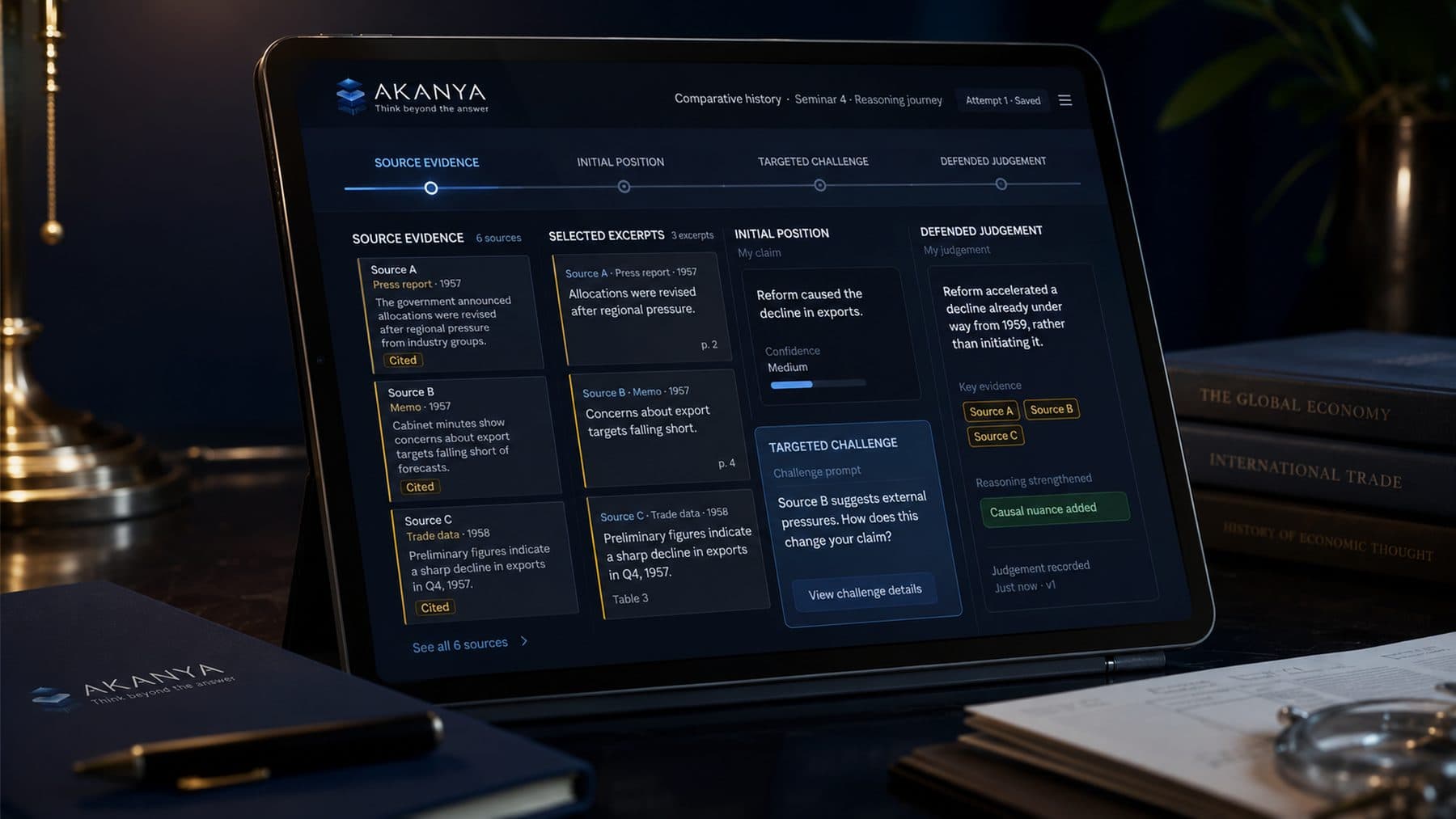
The path from evidence and initial position to challenge, adaptation and final judgement.
What the assessment can see
The same student. Two different records.
A traditional submission ends at the polished answer. The reasoning journey keeps the answer and adds the basis for it.
Evidence marked decisive
Exhibit 5 (capacity at 94 percent), Exhibit 11 (cold chain at 71 percent).
Assumption stated
The second production line will not be commissioned inside eighteen months.
Initial position
Enter all three regions within eighteen months.
Response to challenge
Accepted that the eighteen month plan would launch into regions the business cannot yet serve.
Defended judgement
Staged entry, nearest region first. Position revised, reason recorded.
The same answer, with the path to it attached.
How it works
Build the reasoning journey your assessment needs.
Akanya provides configurable reasoning components that lecturers can use, combine or switch off according to the learning outcome, assessment type and level of assurance required.
Not every assessment needs every component.
Where it matters
Use reasoning touchpoints as a scalpel, not a roadblock.
A weekly tutorial does not need the same level of assurance as a final examination or capstone. Lecturers can choose where deeper reasoning is necessary without placing the entire class under intrusive monitoring.
Final examination
- Recommended reasoning visibility
- Enhanced
- Suggested touchpoints
- Two
- Expected additional cognitive effort
- Redistributed within the existing examination window.
- Suitable reasoning components
- Evidence selection, initial position, targeted challenge, defended judgement.
Deeper reasoning is applied where the consequence of a weak judgement is highest. Everywhere else, the assessment stays light.
Professional competence
AI may support the professional. It should not replace the professional’s judgement.
Future professionals will almost certainly work with AI. Education does not need to recreate a world without technology. It does need to ensure that graduates can evaluate evidence, recognise poor recommendations, explain decisions and remain accountable for the outcome.
- MedicineA recommendation still has to be weighed against the patient in front of you.
- EngineeringA model output still has to be checked against the conditions on site.
- AccountingA reconciliation still has to be interpreted before it is signed.
- LawAn argument still has to survive the facts of the matter.
- EducationA plan still has to meet the class that actually arrives.
- ManagementA strategy still has to be defended to the people carrying it out.
The future professional may work with AI. The qualification must still represent human competence.
Equity and access
Designed for equitable assessment.
Akanya’s core reasoning journey uses low-bandwidth written interaction on the same device used for the assessment. It does not require cameras, biometric monitoring or additional hardware.
No webcam requirement
The reasoning journey is written interaction, not observation.
No biometric monitoring
Nothing about the student's body or face is captured.
No secondary device
The assessment runs on the device already in use.
Low-bandwidth interaction
Text first, designed for constrained connections.
Mobile and desktop
The same journey adapts to the screen available.
Configurable accommodations
Time and component settings can be adjusted per student.
Institution-controlled settings
Accessibility decisions stay with the institution.
Assessment adaptation should not depend on what a student can afford.
Translating policy into practice
Institutional AI policy becomes repeatable assessment practice.
Institutional AI policies establish the principles. Akanya helps translate those principles into repeatable assessment practice, so lecturers are not left to interpret broad policy statements alone.
Akanya could hold the permitted-use position at the level of the assessment rather than the policy document, so a lecturer sets it once when designing the task and the student sees it where the work happens.
How Akanya could operationalise this. Developing alongside institutional pilots.
The reasoning components are chosen per assessment. A faculty can decide that evidence selection and defended judgement are the capabilities that must be visible, and leave the rest of the task unchanged.
How Akanya could operationalise this. Developing alongside institutional pilots.
A quantitative module may need visible working. A law module may need a counterargument. The same framework configures differently rather than imposing one standard across a whole institution.
How Akanya could operationalise this. Developing alongside institutional pilots.
The core journey is written, low-bandwidth interaction on the existing device, with configurable accommodations. Assurance is raised by design of the task, not by monitoring the student.
How Akanya could operationalise this. Developing alongside institutional pilots.
A recorded reasoning journey gives a lecturer something specific to point to in a review: which evidence was marked decisive, what was asked, and what the student did with the challenge.
How Akanya could operationalise this. Developing alongside institutional pilots.
The level of reasoning visibility is a setting, not a rebuild. As capability shifts, faculties can move an assessment class up or down without redesigning the curriculum around it.
How Akanya could operationalise this. Developing alongside institutional pilots.
Global relevance
A global challenge. A locally adaptable framework.
Akanya is being designed for diverse higher-education environments, from large public universities and distance-learning institutions to specialist colleges and professional programmes.
Initial pilot development is taking place with higher-education stakeholders in South Africa, with the framework designed for global use.
Designed for
- Large public universities
- Distance-learning institutions
- Private institutions
- Specialist colleges
- Professional programmes
Compatibility goals
Planned integration- Moodle
- Canvas
- Blackboard
- D2L Brightspace
- Institution-specific LMS
- Ulwazi
Designed to complement existing LMS environments. Integration pathways are part of the pilot roadmap. Ulwazi is listed as an example of a local LMS implementation. No integration is currently live.
Akanya is being shaped by the people who will use it.
The platform is in active development. Lecturer validation, institutional review and real assessment use cases determine what gets built next.

Lecturers and course convenors
Test a reasoning journey on an assessment you already run, and tell us where it breaks.
Join the lecturer pilotFaculties and institutions
Explore assessment governance, risk classification and discipline-specific standards.
For institutionsPolicy and research partners
Work with us on the practice layer between AI policy and assessment design.
Start a conversationPrefer to look first? The guided demo runs in the browser. No account, no setup.

The answer still matters.
The judgement behind it matters more.
Akanya helps institutions preserve the credibility of their qualifications in an environment where answers are easy to produce and judgement is harder to prove.
Think beyond the answer.